FeaturedSmarty Ears Online: 80 activities in your browser, with progress reports for every student. Try it free for 30 days. Learn more →
A farm-themed iPad app for children with childhood apraxia of speech (CAS) and severe speech sound disorders. Children practice sounds, syllables and words step by step, while you collect data on every attempt.

“Whether a child is working on basic, voluntary lip closure or is at the word level and struggling with prosody, Apraxia Farm offers an evidence-based approach to the speech difficulties children with CAS face.”Katie Milligan, speech-language pathologist
Pick the area that matches where each child is right now, and move up as they grow.
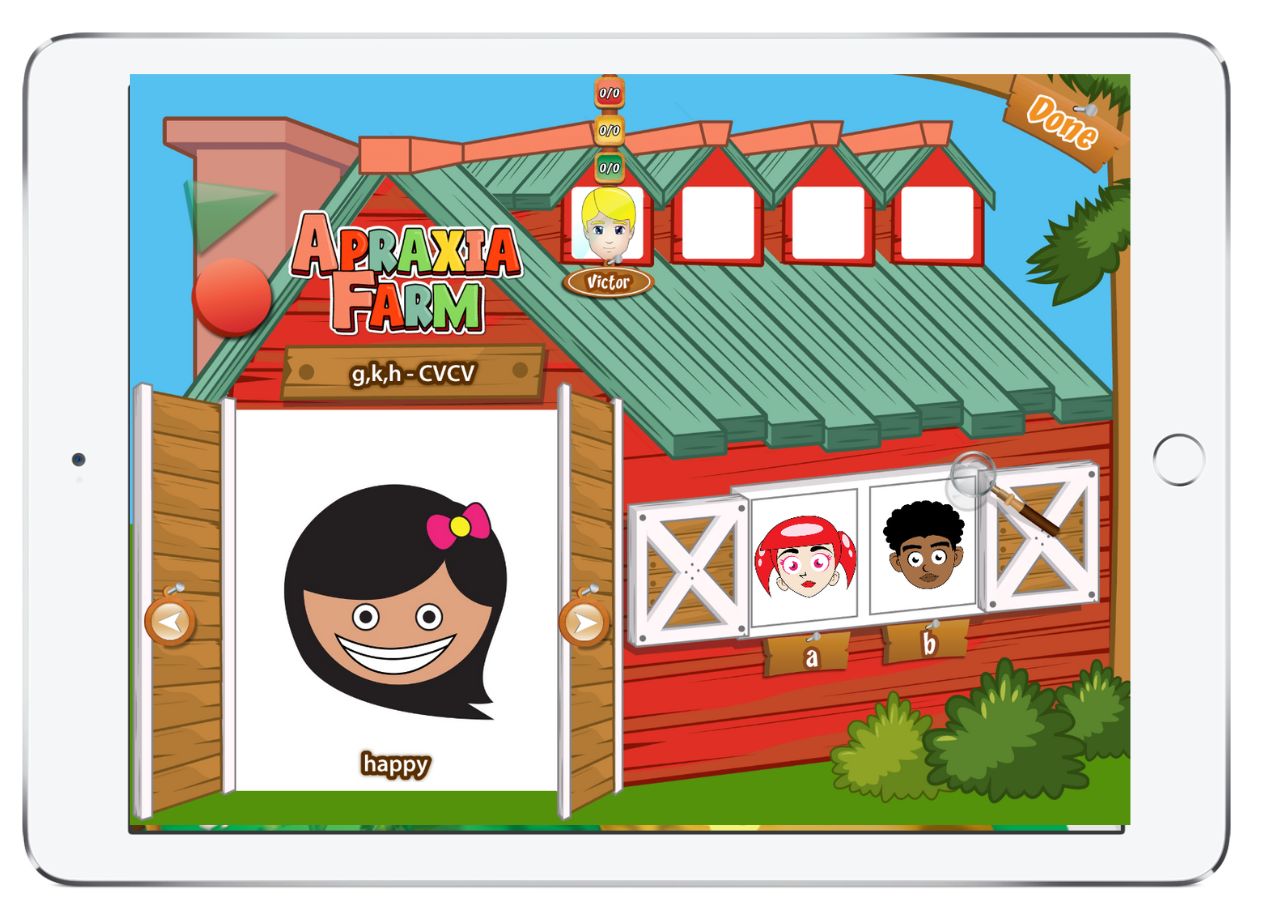
Animated faces show how each consonant and vowel is made. Turn on the iPad camera so the child can watch their own mouth next to the model.
Words are chosen by sound group and syllable shape, from CV and VC words like “bee” to CCVC words like “brick”. Each picture shows the written word too.

Farm animals hold up two or three words to say in a row, so children practice sequences of words and longer, more complex patterns.
Select one or more sound groups (consonants, short and long vowels, blends and diphthongs) and the syllable structure for every player. Combine them to tailor each session.
Functional words matter most. Add photos of family members, teachers, pets or favorite things, record the word in your own voice, then choose its sound and syllable structure. It joins the word list for every student.
Group sessionsEach player has their own targets, so a whole group can practice together. Tap a player’s avatar to switch who is talking, and Apraxia Farm keeps everyone’s data separate.

Score every production as you go. Reports break results down by consonants, vowels, syllable structure and session history, and you can listen back to the child’s recordings.

Children with CAS need many, many practice attempts. Apraxia Farm makes those extra minutes at home fun, and keeps them in step with therapy.
“The extensive customization options allow me to target the specific needs of my students, and I especially appreciate the feature that lets me add my own words. The ability to print homework directly from the app is a feature I’ve not found elsewhere.”
“Apraxia Farm has definitely been a motivating application for my students who prefer animated and illustrated images, or need an animated cue of mouth movement on an age-appropriate model instead of staring at my face all of the time.”
“Old MacDonald wishes his farm had this much going on! The farm theme is cute and engaging without being too busy, which is a great balance for my little friends.”
“The app takes into consideration the increasing complexity we use to target words: sound, syllable, words and combining words. Printing homework is a huge plus, because finding words in just CV or VC can be difficult!”
Apraxia Farm is also one of the activities in Smarty Ears Online, our web platform for speech, language and literacy. Practice words by sound and syllable shape on any computer or tablet, with a webcam mirror and audio recording built in.
Results go into the same caseload as every other Smarty Ears activity, so all of a child’s goals live in one place.

| Apraxia Farm app | In Smarty Ears Online | |
|---|---|---|
| Where it runs | iPad | Any modern browser on computers and tablets |
| How you get it | One purchase on the App Store | Included with a Smarty Ears Online subscription, along with hundreds of other activities |
| Self-monitoring | iPad camera and audio recorder | Webcam mirror and audio recorder |
| Progress data | Reports and homework sheets in the app | Reports alongside your whole caseload |
| Best for | Sessions on one iPad, even offline | Teletherapy, school teams and districts |