Ask a room of speech-language pathologists for their favorite low-prep game and Go Fish comes up again and again. It needs nothing but a deck of picture cards, every child already knows the rules, and it has something most drill activities don’t: a reason to talk. Every turn starts with a question, and every question is a chance to practice a target sound.
Here’s how to get the most speech practice out of a game of Go Fish, at the table or on a screen.
Why Go Fish works so well in speech therapy
- The carrier phrase is built in. “Do you have a…?” moves practice from single words to phrases without a worksheet. Students say the target word inside a natural question, which is exactly where carryover has to happen.
- Lots of repetitions, without it feeling like drill. A student asks for a card, says the card they catch from the pond, and says the pair they lay down. That’s several productions per turn.
- Familiar rules mean low cognitive load. Students aren’t busy learning a new game, so their attention can go to their sound.
- Social skills come along for free. Taking turns, asking a partner, answering “Yes, here you go” or “Go fish!”, and winning or losing gracefully.
Setting up the deck
Go Fish with pairs is the easiest version for therapy. You need two cards of each picture.
- Pick 6 to 10 target words. Six pairs make a quick game of about ten minutes; ten pairs make a longer one with a bigger pond.
- Choose the position on purpose. Keep the sound in one position (beginning, middle or end of the word) while a student is still building accuracy, and mix positions once they’re ready.
- Add one or two easy words. A couple of words the student already says well keep the game moving and the confidence up.
- Deal 3 or 4 cards each. The rest go face down in the middle: that’s the pond.
The speech rules
Keep the classic game, and add a few rules that turn every turn into practice:
- Ask with the whole phrase. “Do you have a cake?”, not just “Cake?” Model it the first few times.
- Answer with a phrase too. When a partner asks, the answer is “Yes! Here’s my cake” or “No. Go fish!”
- Say the card you catch. After “Go fish!”, the student names the card they pulled from the pond, so even a missed turn is a practice turn.
- Say the pair. When a pair goes down, the student says the word one more time, or puts it in a sentence.
- Every try counts. If a production isn’t quite there, model it and let the student try again before the turn moves on. Each try is more practice, not a penalty.
Tip: Let the student ask you for cards too. Hearing your model of the target word in the same phrase, turn after turn, is built-in auditory bombardment.
Make it easier or harder
- Word level: skip the question. The student names the card they’re asking for, and names each card they catch.
- Phrase level: the classic “Do you have a…?” and “Here’s my…”
- Sentence level: add a describing word (“Do you have the red car?”) or a reason (“I need the cake to make a pair”).
- Conversation and self-monitoring: the student judges their own production before you do, or keeps their own tally.
Go Fish works for language goals too: ask by category (“Do you have an animal?”), practice a and an (“an apple”, “a banana”), plurals (“Do you have two cats?”), or answering yes/no questions.
Playing in a group
Go Fish is a natural fit for groups of two to four. Each student can have their own target sound: a student working on /s/ asks for /s/ cards while their partner asks for /r/ cards. Peers hear each other’s models, and turn-taking keeps everyone engaged while you listen and score.
Taking data without stopping the game
Keep a simple tally for each word: correct, almost, or try again. Notice the difference between the first time a student says a word and the last time; that change within a session is often the clearest sign that practice is working. Note asks and catches separately if you can, since a sound said inside a question is a step beyond the single word.
Speech Go Fish in Smarty Ears Online
We loved Go Fish so much that we built it into Smarty Ears Online. In Speech Go Fish, students play against Finn, a friendly fish, at a lakeside dock:
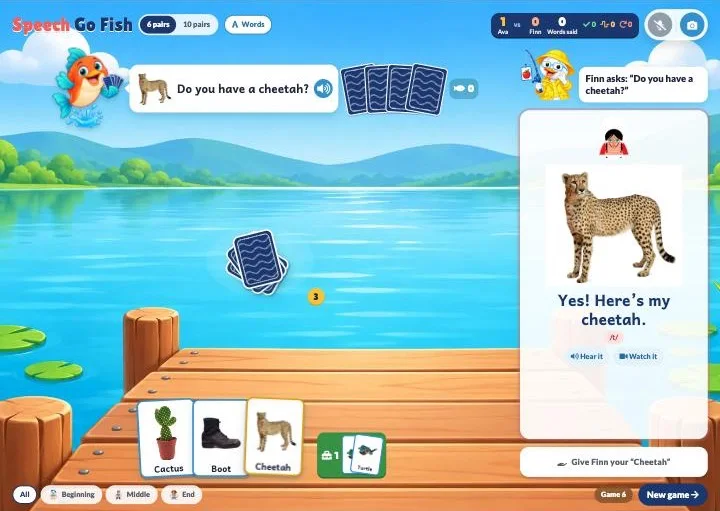
- The deck comes from each student’s targets. Pick sounds by age, position, phonological process or cycle in the speech sounds window, and the cards are dealt from picture cards with those targets. The same list carries over to the other word-level speech games.
- Students ask Finn “Do you have a…?” If Finn has it, they make a pair and go again. If not, it’s “Go fish!” and they tap the pond to catch a card and say it. When Finn asks, they answer “Yes! Here’s my…” or “Go fish!”
- Every try is scored and saved. Tap correct, almost or try again each time the student says a word. Asking and answering are saved as phrases, and cards caught as words, so the session report shows both levels and compares each word’s first try with its last.
- Hear it and watch it. Every card has its recording, and words picked by sound have a video model of a real person saying them.
- Quick or long. A quick game is 6 pairs and a long game is 10, and you can practice one position in the word or all of them.
- Groups and Spanish. Up to four students can play in one session, each with their own cards and score, and the game plays in English and Spanish.
It sits alongside the other speech games in Smarty Ears Online, like Articulation Flashcards, Speech Bingo and Articulation Basketball, so you can switch games without setting targets up again.
Take Go Fish home
Go Fish is one of the easiest games to send home. Give families a set of picture cards and the two phrases (“Do you have a…?” and “Here’s my…”), and ask for five minutes a few times a week. A familiar game with a parent or sibling is often the practice that actually happens between sessions.
 How Parents Can Help Children with Speech Sound Disorders
 Revolutionizing Spanish Articulation Therapy: How Smarty Ears Online Empowers Spanish-Speaking SLPs and Students
 Why I Love Articulation Scenes