FeaturedSmarty Ears Online: 90+ activities in your browser, with progress reports for every student. Try it free for 14 days. Learn more →
Speech & articulation

Why I Love Articulation Scenes

📅 March 2, 2022⏱️ 2 min read
In this article
  • Articulation Scenes turns hidden-picture scenes into speech sound practice.
  • Each of the four activities gets a fun twist, from timed searches to fill-in-the-blank stories.
  • The same scenes also work for fluency and language goals.

I am always looking for ways to make articulation practice fun. Picture cards and worksheets work, but if I get bored, I know the kids are bored too. Hidden pictures are a fun way to work on target sounds, and Articulation Scenes brings that twist to my iPad, along with more options to spice up articulation therapy.

Here is how I use it in a traditional articulation session, with a few twists.

1. Find the hidden items

  • Touch each word and find it in the scene.
  • Touch a picture and say the word, or make up a sentence.
  • Twist: set a timer and see how many items you can find and say correctly.

2. Tap and say it

  • Touch each word and record your voice.
  • Touch each word and record a sentence.
  • Twist: create a silly sentence using two or more pictures in the scene.

3. The Movie Theater

  • Listen to the story, read the script and record it.
  • Create your own story and record it.
  • Twist: create and record your own story, but don’t let anyone hear it yet! When you finish, have others listen and count how many items from the picture they heard in your story.

4. The Production Room

  • This area helps students generalize correct sounds.
  • Create and record your own story, or use the scripts provided.
  • Twist: record your story but leave out the target words, and have others guess which word from the scene fits best. For example, for the R-blends scene: “One day I rode on a ___ to the beach (train). I sat in my chair and ate ___ (grapes). My ___ (friends) played in the sand. Suddenly a ___ (dragon) flew over us and we ran to the castle.” You can say “blank” or toot a horn or ring a bell for each missing word.

More “twisted” ideas

I always use apps in as many ways as possible, and this one is no exception. I use it in language and fluency sessions too.

Fluency

  • Use the scenes to practice easy speech in words.
  • Practice easy speech in sentences and stories.
  • Recording helps students notice stuttering and easy speech patterns.

Language

  • Work on syntax: he, she, they, is, are, and more.
  • Give clues describing an item in the scene and have others guess: “I spy…”
  • Work on positional concepts: find items between, next to, on, and so on.
  • Practice asking questions: Where is the ball? Who is walking? What is purple?
  • Work on sequencing by telling a story about a scene with a beginning, middle and end.

And don’t forget the homework documents! Send them home as traditional practice sheets, or “twist” them by adding directions for creating stories or any of the ideas above.

An Articulation Scenes homework sheet

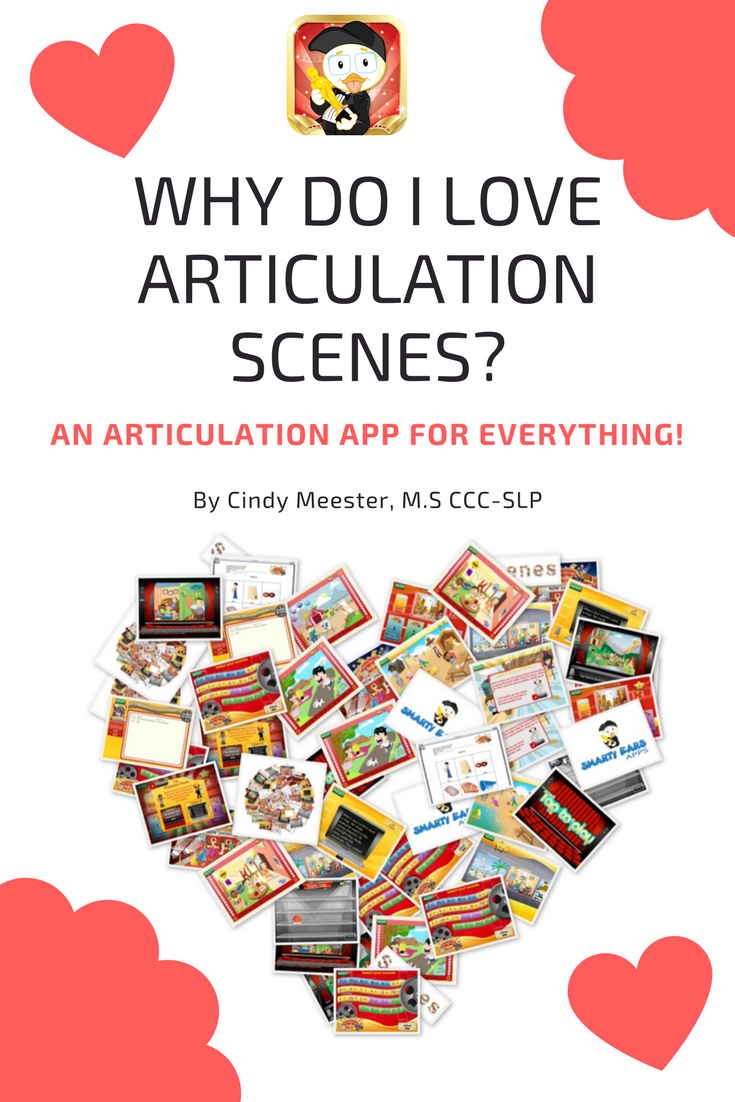
Why I love Articulation Scenes, illustrated

Articulation Scenes app icon

Try Articulation Scenes

Hidden-picture scenes for practicing speech sounds at the word, sentence and story level.

Speech Prompter in Smarty Ears Online
Smarty Ears Online · 14 days freeSpeech sound practice for your whole caseload

Pick a sound and its position, and Smarty Ears Online brings up the practice words, scores each try with one tap and builds a speech sound profile for every student.

Basic Professional: 14 days free, then $29 a month. Cancel anytime.